skip to main |
skip to sidebar
Web Hosting
Web hosting is an internet service that allows individuals and organisations to make their own website accessible through the World Wide Web. Web hosts are companies that provide space on a server they own or lease for use by their clients as well as providing connectivity to the internet, typically in a data centre. Web hosts can also provide data center space and connectivity to the Internet for servers they do not own to be located in their data center, called cocolation.
Domain Name Registration
A domain name is an identification label that defines a realm of administrative autonomy, authority, or control in the internet, based on the Domain Name System (DNS). They are effectively names used as simple identification labels to indicate ownership or control of a resource. Individual Internet host computers use domain names as host identifiers, or hostnames. Hostnames are the leaf labels in the domain name system usually without further subordinate domain name space.
An important purpose of domain names is to provide easily recognisable and memorable names to numerically addressed Internet resources. This abstraction allows any resource (e.g., website) to be moved to a different physical location in the address topology of the network, globally or locally in an intranet.
Demographic Profile
1) Age: 16-21 – during secondary school, or just leaving and going to uni.
2) Gender: Males and Females
3) Educational Background: Different ranges of education - mostly at secondary school, sixth form or starting university
4) Social Background: various different social classes
5) Economic Status: Various different Economic Status' depending on the parents
In terms of demographics our audience covers a broad range of people. as it does not fit exactly into specific category. The one thing our audience do have in common is their age group, as this is the age where most people experiment or face temptations of smoking, drugs and alcohol. This is also the time when most people are most vulnerable as they are faced with the aspect of peer pressure.
I can't define a specific category that parents would put into because it all depends on their age, economic status etc, which differs within certain families.
VALS – Values, Attitudes, Lifestyles
EXPERIENCERS:
Young, impulsive and rebellious - these people act in the moment making them easily susceptible to peer pressure and taking drugs etc to look good with their friends, they want to rebel and stand out.
They like new products and styles but soon tire of them and search for novelty – this could mean they get bored easily so would result to drugs and also once they’ve tried one they are more likely to try more and more dangerous ones
They spend as much as they can afford on clothing, fast food, music and films – they don’t think too carefully about where they spend their money so if it goes on alcohol, smoking and drugs it would not matter.
STRIVERS:
Tend to be unsure of themselves and have a low income. They are striving for approval from others, which they feel they could gain by ownership of possessions, most of which they cannot afford. – these people are most easily influenced by others and have a weakness for peer pressure. They mostly get pressured into drugs for approval but don’t have the money to keep a drug addiction up so would be most likely to end up homeless because of it and ruining their lives. These are the people who need the most serious help from our website.
Young Psychographics
These cover a whole range people, and i like to think we have taken all into consideration;
TRENDIES: those who crave the admiration of their peers – give in to peer pressure
EGOISTS: people who seek pleasure – enjoy the feeling of drugs and don’t think about the consequences
REBELS: wish to remake the world in their image – take drugs to stand out and be different by breaking the rules
GROUPIES: just want to be accepted – (opposite to REBELS and similar to TRENDIES) take drugs because their friends are
DROP OUTS: shun commitments of any kind – given up on school etc so find alternative ways to occupy their time and hang around with the wrong crowds
UTOPIANS: want the world to be a better place – people who visit the site to get advice and help out their friends or family who are addicted

 I have focused on and researched campaign websites. I have discovered that campaign websites usually follow similar conventions of layout and the ways win which they work. This has influenced my general idea of how i am going to layout my website. Conventions include aspects such as;
The Logo – most likely to be in the top left corner of the website , this is very eye catching and is what you will recognize to identify the website. There are different styles of logo which can vary from a simple but memorable image, to others being the full focus of the title page and groundwork for the general theme of the site .
Slogan – not common amongst many websites, however some websites choose to have a slogan next to their logo.This helps you remember the name of the website and also its aim for what it sets out to do.
Navigation Toolbar – normally situated in the centre at the top of the page, under the logo and is in a big clear font. This is the easiest and most efficient place to access the navigation bar and makes it easier for users to refer back to it.
Bottom of the Page – not very interesting for the viewer, however it usually includes a sign that the site is copyrighted which enforces professionalism.
Most sites also include a search bar, these are very popular as they create even more specific navigation around the site, and enables the audience to search for exactly what it is they’re looking for on the website.
Drop Down Lists – an easy way to list information. A simple format allows and encourages users to use this easily.
Images – all relate to the content of the site, however there are different angles. For example; for drugs you have Talk to Frank which shows the negative side of drugs, which influences people to not take them as it only shows the bad consequences. You have other sites which show people who have been reformed and are telling inspirational stories of how their lives have changed for the better since they have been off drugs. They both serve the same effect but use different tactics to work.
Colour schemes – usually about 3 main colours formed from the logo and text but other colours used around site to add interest and emphasis on certain parts.
Language – The websites similar to mine engage the audience offer help and advice. Telling the audience the main points they need to know without getting side tracked and going off the subject. The language is persuasive and directed at the audience.


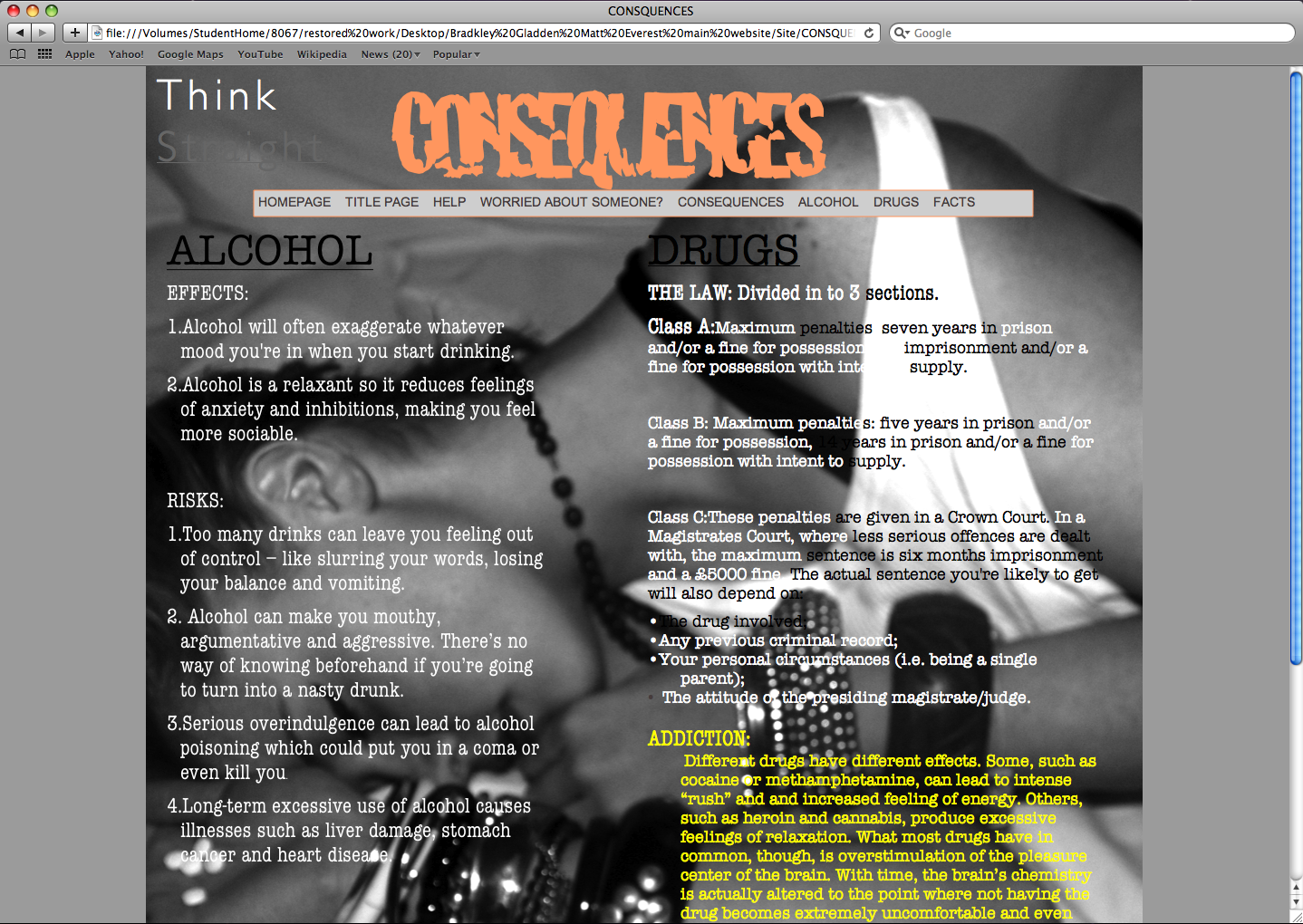


 I have focused on and researched campaign websites. I have discovered that campaign websites usually follow similar conventions of layout and the ways win which they work. This has influenced my general idea of how i am going to layout my website. Conventions include aspects such as;

